The Roman Empire had been expanding out of the Italian peninsula and finally found it’s way to Iberia as Roman and Carthaginian forces battled for control of the Mediterranean, and sadly the peace known around Ronda was shattered beginning in the 2nd century BC. Rome and Carthage fought two bloody and protracted wars, with Spain suffering terribly as Roman armies vied for control of key supply routes.
Scipio Emilianus himself ordered the construction of a castle at Ronda, which in it’s day was known as the “Castle of Laurels”. The foundations of this castle lie beneath the Iglesia Convento de la Caridad in Plaza Duquesa de Parcent, right in the heart of Ronda’s old town.
Romanization of Spain happened very quickly once Roman legions had pacified the peninsula, and most linguistic and cultural groups were assimilated into the Roman Empire becoming the forebears of today’s modern Spaniard.
The defeat of Carthage brought only a momentary peace to Ronda and surrounding areas, and by 45 BC the district castle and town was destroyed once again during the Roman civil war that pitted Julius Caesar against Pompey the Great.
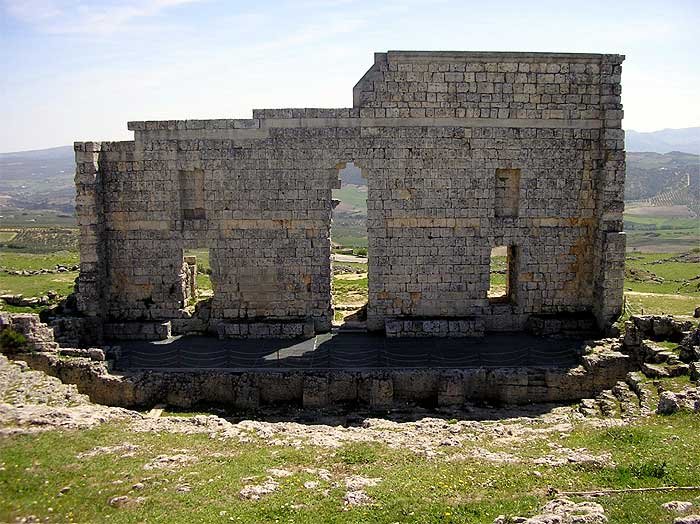
The 1st century AD brought a renewed peace and prosperity to the Serrania, Acinipo grew into a modern Roman City with Amphitheater and the right to mint its own coins, in fact Acinipo has been mentioned as one of the more important Roman towns in Iberia.

The collapse of the unified Roman Empire in 395 brought Ronda and the rest of Iberia under the control of the Western Roman Empire, although by 409 much of Iberia had been overrun by Germanic Vandals, Suevi, and Alans, and so weak had the empire become that Rome itself was sacked for the first time in its 800 year history.
In 440, the Suevi under Rechila are known to have been in control of both Acinipo and Arunda, however they, and the vandal tribes control over Iberia was short lived. By the end of the 5th century the Kingdom of the Visigoths was dominant in much of Iberia, the Vandals had been pushed into North Africa and the Alans and Suevi brought under Visigothic rule.
Visigothic Iberia never really knew much peace, it was troubled with a series of bloody disputes over succession to the throne at Toledo, culminating in the defeat of Agila I when the citizens of Córdoba revolted in 550 AD killing his son and destroying the royal treasure.
Seville fell to Athanagild in 549 or 550, who declared himself king in opposition to Agila I, and at some point in 552 the assistance of Justinian, emperor of the Eastern Roman Empire, was requested to help settle the dispute.
Justinian had long held ambitions of reuniting the Eastern and Western Roman Empires and immediately dispatched an army which landed at Malaga in June of 552, then joined forces with Athanagild’s army and marched on towards Agila I’s army around Seville.
By 554 Justinian’s army in Iberia had taken control of most of Southern Spain’s coastal land and the Balearic Islands, while Athanagild reigned in the North. A new province of the Eastern Roman Empire known as Hispania was formed and included the cities of Malaga, Cadiz, Almería, Cartegena, Valencia, and of course Arunda.
Acinipo had been destroyed by the time of the founding of the Hispania province, never to be rebuilt, whilst Ronda became a prize worth fighting for due to its location above the Tajo gorge. The Byzantines immediately set about rebuilding Arunda and redeveloping the farmland, but their efforts were short-lived, by 624 the Visigothic Kingdom had finally reasserted its influence in Hispania and driven the Byzantines back to Constantinople.
[wp_ad_camp_2]

I’ve been living in this lovely area of Western Andalucia for the last 20 years or so and dedicate most of my time to the running of English language tourist information websites for the towns of Cádiz, Ronda, Grazalema, the famous or infamous Caminito del Rey, and also Wildside Holidays, which promotes sustainable and eco-friendly businesses running wildlife and walking holidays in Spain. My articles contain affiliate links that will help you reserve a hotel, bus, train or activity in the area. You don’t pay more, but by using them you do support this website. Thankyou!