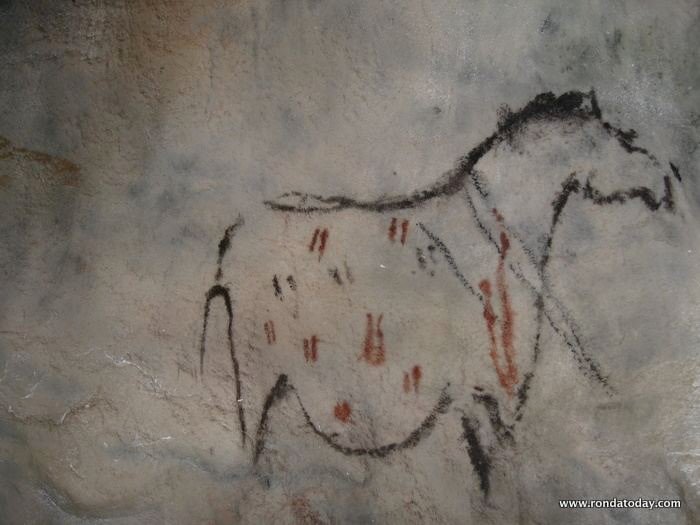
As far back as pre-Roman times Ronda has occupied an important role in this part of Southern Spain because of it’s high cliffs, deep gorge, and easily defensible position on a main trade route. Located on one of the main routes inland from southern coastal ports, Ronda and it’s older but now ruined sister city Acinipo, have together been occupied since at least 1,100BC.
Paleolithic and Neolithic people roamed the hills around Ronda leaving many fascinating reminders of their presence, including cave paintings at Cueva de la Pileta, dolmen burial sites near Montecorto, and in the Grazalema Natural Park, and numerous sites where archeologists have discovered stone age pottery and other relics.
Cueva de la Pileta is open to the public and your guide will show you all the important cave art in an easy walk through the cave that takes about two hours. It’s fascinating to think that the very land we live on in the 21st century was also inhabited in historical times ancient humans and maybe even Neanderthal tribes.
It is tempting to imagine life for the cave dwellers who called Ronda home all those thousands of years ago, picture a small tribe of maybe 20 or 30 individuals hunting deer, or wild boar, and sitting around a campfire in the valleys below Ronda, with skins drying in the summer heat with a knowledge that they would be needed when the autumn rains appear, and more so, in the bitter cold of winter.
The descendants of these cave dwellers are believed to be Tartessian, or at the very least closely related to Tartessians, an indigenous people to Southern Portugal and Western Andalucia. It is commonly thought that the Tartessians were Celtic, but linguistic evidence suggests the Tartessian language was unrelated to any of the other languages of Iberia. It is possible the Tartessian people were the same builders of the dolmen burial chambers seen scattered around the mountains of the Serrania.
Around 1,100 BC the Phoenicians, later known as Carthiginians settled in Iberia and founded Cádiz, as well as numerous other villages, including Acinipo, whilst Greek merchants arriving much later established a trading post in Ronda.
Acinipo is a Roman corruption of the Phoenician name of the town which translated means “Land of Wine”, whereas Ronda, which was settled by Greek merchants, was known to the Greeks as Runda, and roughly translated means “surrounded by mountains”.
The Tartessians, Phoenicians, and Greeks are believed to have lived in relative harmony for hundreds of years, and in fact Tartessian culture is known to have directly benefited from it’s close association with both in the development of their own writing system from the 7th century BC.
Strabo, a Greek historian who lived from 64 BC to 24 AD wrote that most of the indigenous peoples of Spain claimed to have written histories going back as far as 6,000 years which ties in nicely with the neolithic evidence found in these parts.
By the 6th century BC Celtic peoples from the north had arrived and taken control of the area and mixed with the Tartessian descendants, the Turdetani. Collectively the area controlled by the new Celtic peoples became known as Beturia, which stretched from the Rio Guadiana to the Guadalquivir River.
Pliny the Elder in his “Third Book Of The History Of Nature” describes the towns of Acinippo and Arunda as being within the region of Beturia, and specifically the part controlled by Celtici whilst the other part, further to the west and north were still controlled by the Turduli.
Evidence suggests when the Celts first arrived in Iberia and started to settle that vast parts of the countryside emptied in their wake, and current thinking suggests the Turdetani simply abandoned the areas around Ronda and Acinipo either before the Celts arrived, or around the same time.

I’ve been living in this lovely area of Western Andalucia for the last 20 years or so and dedicate most of my time to the running of English language tourist information websites for the towns of Cádiz, Ronda, Grazalema, the famous or infamous Caminito del Rey, and also Wildside Holidays, which promotes sustainable and eco-friendly businesses running wildlife and walking holidays in Spain. My articles contain affiliate links that will help you reserve a hotel, bus, train or activity in the area. You don’t pay more, but by using them you do support this website. Thankyou!